If you have been told you should be more active after 50, you have probably not been told what that actually means in practice. The national guidelines are more specific than most people realize, and they ask for less than most people fear.
What the guidelines actually say
The National Institute on Aging puts it plainly: older adults can benefit from all three types of exercise, aerobic, muscle-strengthening, and balance. The number most often quoted alongside that is 150 minutes of moderate-intensity aerobic activity a week, plus two days of muscle-strengthening activity. Those come from the federal Physical Activity Guidelines for Americans.
You can read both sources directly: Health Benefits of Exercise and Physical Activity from the National Institute on Aging, and the Physical Activity Guidelines for Americans, 2nd edition.
150 minutes a week sounds like a lot until you divide it. It is about 22 minutes a day. Or two coached hours plus a couple of walks. Or three sessions of 50 minutes. Written as a weekly total it sounds like a project. Written as your actual week, it is smaller than most people assume.
Three types, not one
This is the part that gets lost. Most people who decide to get active start walking, and walking is genuinely good. But walking is aerobic work almost exclusively. It is not muscle-strengthening, and it is not balance training.
The guidance for older adults names all three separately, and balance gets its own line rather than being folded into the rest. If your entire routine is a morning walk, two of the three categories are simply not happening.
What that looks like in a class
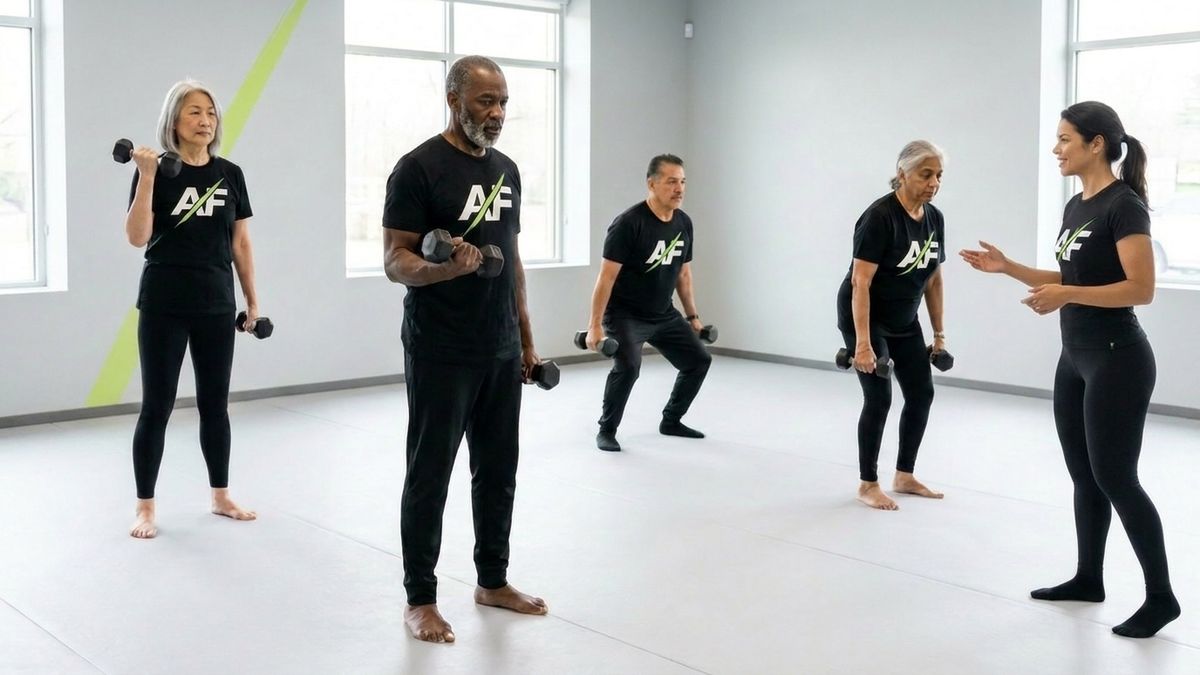
Every Active Fit 55+ class moves through four pillars, and each has its own equipment so nothing gets mixed together in one confusing drill.
Agility and balance is agility-ladder footwork and standing balance work, shifting weight from foot to foot. Resistance is band pull-aparts and rows. Strength and conditioning is light dumbbells: curls, presses, rows, chair-to-stand, carries, wall push-ups, core and posture work. The low-impact interval block is grounded cardio only, marching and step-touch and low-impact step-jacks. No jumping, no running, no burpees. Both feet never leave the floor.
Line those up against the three categories and you can see why the class is built the way it is. The aerobic piece, the muscle-strengthening piece, and the balance piece each get their own block of the hour instead of one of them standing in for all three.
It is not too late, and that is not a pep talk
The NIA page says it in as many words: it is never too late to start being physically active and to achieve the benefits of an active lifestyle. That is not motivational filler, it is the position of the national institute whose entire job is aging.
In practice, what that means in this room is that complete beginners are common. Not tolerated, common. Nobody assumes you know what a row is. There is no fitness test and no baseline you were supposed to arrive with.
What we are not going to tell you
You will find plenty of pages that list everything exercise is supposed to do for your health. We are not going to make those promises about this class, because a fitness program is not medical care and anyone promising otherwise is overselling.
What we will tell you is exactly what happens in the room: coached movement, scaled to you in real time, in a group of people your own age. What the general research says about physical activity is available above, from sources with far better credentials than a gym website.
Before you start
Check with your doctor before starting any new exercise program, especially if you have joint, heart, or balance concerns. Our coaches guide safe movement. They do not diagnose or treat anything, and this program makes no medical claims.
Come try one
Your first class is free, and an hour tells you more than any article will. Call 951.337.3781 for current class times. Riverside, CA.
Active Fit 55+ is a general fitness program, not medical care. It does not diagnose, treat, cure or prevent any disease or condition. Always consult your physician before beginning any new exercise program.