There’s a good chance you’re not reading this for yourself. You’re reading it for your mother, or your dad, and the word “bootcamp” made you nervous — fairly. We’re not going to answer with reassurance. Reassurance is cheap and every gym website has it. Here’s a description instead. Read it and decide.
What a coach is actually watching
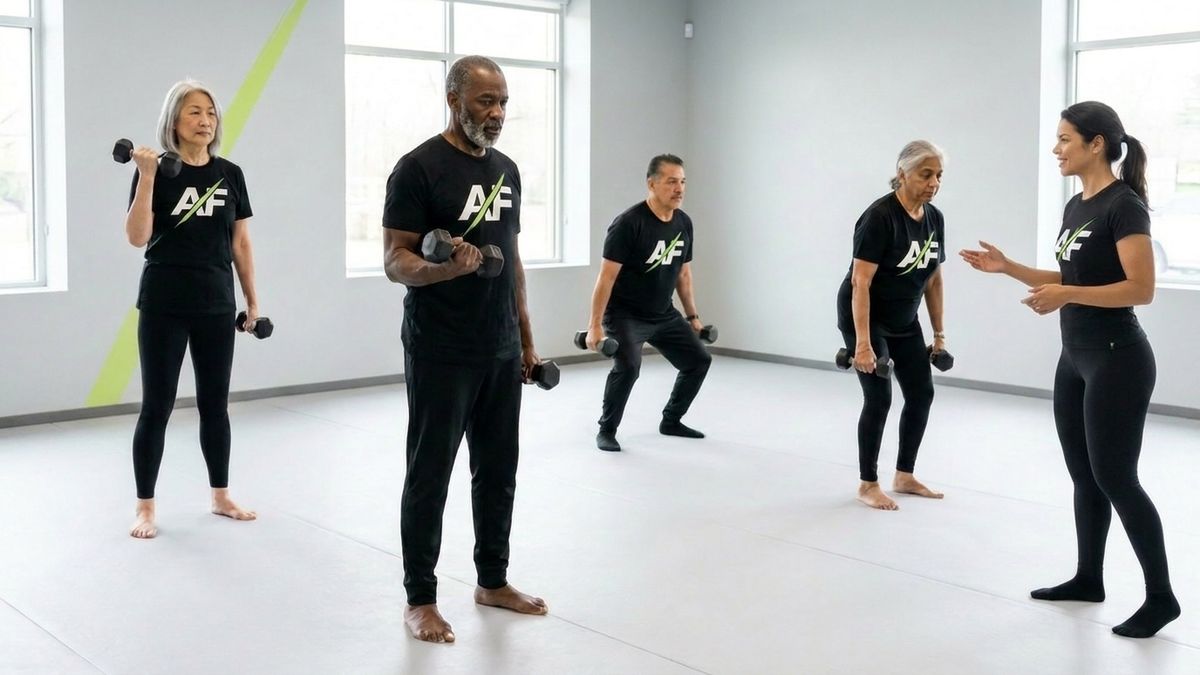
While the room is working, Coach Zaide and Professor Carlos Miller are walking it. They’re not counting. They’re watching a short list of things.
Breathing — is someone holding their breath through a movement, which usually means it’s harder than they’ll admit. Grip — a hand slipping on a dumbbell means the weight is wrong for today. Knees — whether they’re tracking over the toes or drifting inward on a sit-to-stand. Shoulders — creeping up toward the ears on band work means the band is too heavy. And the face. People will not tell you a movement hurts. Their face tells you first.
How a movement gets changed mid-class
Nothing about this is dramatic. It usually looks like a coach stepping over, saying two sentences quietly, and moving on.
A standing balance drill becomes the same drill with a hand on a wall. A step becomes a lower step, then marching in place if the knee isn’t having it. A dumbbell gets traded for a lighter one, or set down entirely and the movement continues with bodyweight. Band pull-aparts get done with the hands wider, which makes the band easier — same exercise, less tension. A floor exercise becomes a chair exercise.
The rest of the class keeps going. Nobody announces it. Nobody stops and looks.
What happens when a knee acts up
Say your dad’s knee starts talking to him twenty minutes in. Here’s the actual sequence. He tells the coach, or the coach notices. He stops that movement — no negotiating, no “push through it.” The coach gives him something for the same part of the body that doesn’t load the knee: seated rows, band work for the upper body, core work, a carry. He keeps training. He does not sit in the corner feeling like the guy who broke, and he does not go home early having wasted the trip.
If something’s genuinely wrong, class is over for him that day and we say so. We’d rather someone miss one class than train through an injury.
Why socks on mats
Active Fit 55+ runs on the same clean, white padded mats we use for jiu-jitsu, and everyone trains in socks or bare feet. Three reasons. The mats absorb load, so standing and stepping work is softer than it would be on a wood floor or concrete. Bare or socked feet feel the ground better, which matters for balance work — a cushioned running shoe puts a mattress between the foot and the floor. And a shoe with a raised heel or thick sole is its own trip hazard on a soft surface.
It also means there’s no gear to buy. Comfortable clothes, socks, water.
What isn’t in the class at all
No jumping. No running. No burpees. No box jumps. No one screaming. Both feet never leave the floor at once, in any movement, at any point.
The part we can’t answer
Whether class is right for your parent is a question for their doctor, not for us. Check with a physician before starting any new exercise program — especially with heart, joint, or balance concerns. Our coaches guide safe movement. They don’t diagnose or treat anything, and this program makes no medical claims.
Come watch one
The best version of this article is standing in the room. First class is free, and family is welcome to come sit and watch it. Call 951.337.3781.
Active Fit 55+ is a general fitness program, not medical care. It does not diagnose, treat, cure or prevent any disease or condition. Always consult your physician before beginning any new exercise program.